The Kansara community is one of the oldest occupational artisan groups of the Indian subcontinent, traditionally associated with metalworking, Rogan painting and allied crafts. The word “Kansara” itself is derived from kansa—a copper-based bronze/brass alloy—indicating a hereditary profession rather than a geographic origin. This makes the Kansaras part of India’s ancient shreni (guild) system, where specialized skills were preserved and transmitted within families over centuries.
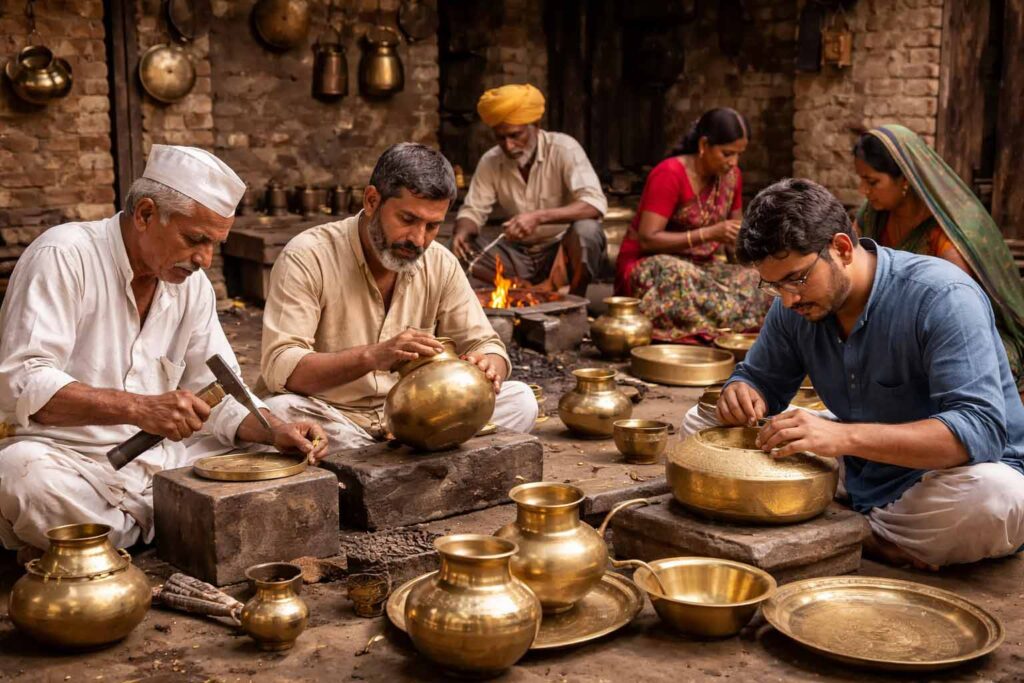
Ancient and early historic period
Archaeological evidence from the Indus–Saraswati civilization (c. 2600–1900 BCE) shows advanced knowledge of copper and bronze metallurgy, including alloying, casting, and finishing of utensils and ritual objects. Communities like the Kansaras are widely understood to be the hereditary custodians of this metallurgical knowledge. Their techniques—controlled smelting, mold casting, hammering, and polishing—reflect continuity from these early traditions into later historical periods.
Metal utensils made of kansa were not merely domestic items; they held ritual and medicinal significance in Indian society. Classical Ayurvedic and ritual texts refer to the use of bronze/brass vessels for cooking, eating, and temple rituals, reinforcing the social importance of Kansara artisans in sustaining everyday and sacred life.
Medieval period and guild traditions
During the early medieval and medieval periods, Kansaras were organized into local craft guilds attached to towns, temple economies, and royal centers. These guilds regulated training, quality standards, and pricing. Kansara workshops supplied courts and temples with lamps, vessels, bells, and ceremonial objects, while also meeting the needs of agrarian households.
In western India—especially Gujarat, Rajasthan, and Kachchh—the Kansara community flourished due to strong trade networks. Ports and caravan routes enabled the circulation of metal goods, raw materials, and stylistic influences. Over time, certain Kansara families diversified into Rogan art, precious metalwork, becoming skilled gold and silver jewellers serving local elites and ritual markets.
Early modern period and regional diversification
By the early modern period, Kansara artisans had become deeply embedded in regional cultures. In Gujarat and Kachchh, their work absorbed local motifs and techniques, while interaction with other artisan communities encouraged skill-sharing. In craft-rich regions like Kachchh, Kansaras existed alongside weavers, embroiderers, leather workers, and Rogan painters.
It is within this broader artisanal ecosystem that connections with Rogan painting emerged. Rogan painting—an oil-based textile painting tradition using castor oil and natural pigments—was practiced in limited pockets and often sustained through close-knit artisan networks. Kansara families, already skilled in material preparation and tool use, were part of the social and economic environment that allowed such specialized arts to survive.
Colonial period and decline of traditional markets
The colonial period marked a major disruption. Industrially manufactured metal utensils and imported goods began to replace handmade kansa ware. British revenue policies, factory production, and changing consumption patterns weakened guild systems and reduced demand for artisanal metalwork. Many Kansara families faced economic decline, forcing some to abandon their hereditary craft or shift to repair work, petty trade, or wage labor.
Despite these pressures, certain families preserved traditional knowledge, particularly in ritual metalware and jewellery, which retained cultural value even as everyday usage declined.
Post-independence era and contemporary situation
After Indian independence, handcrafts were formally recognized as cultural heritage, but institutional support remained uneven. While some Kansara artisans benefited from cooperative societies and urban markets, many continued to struggle with rising material costs and limited visibility.
In regions like Kachchh, renewed interest in traditional arts—such as Rogan painting—has brought attention to individual master artisans and living workshops. However, the Kansara community as a whole remains under-documented in mainstream craft narratives, despite its deep historical roots.
Conclusion
The history of the Kansara community is inseparable from the history of Indian metallurgy and craft civilization. From ancient bronze-working traditions and medieval guilds to survival through colonial disruption, Kansaras have been silent builders of material culture. Their legacy—kansa metalwork, silver and gold jewellery, and connections to rare arts like Rogan painting—represents a continuous line of indigenous knowledge that deserves deeper recognition, documentation, and protection today.