The history of the Kansara Samaj is a remarkable narrative of adaptation, survival, and metallurgical excellence. For nearly a millennium, this community has served as the backbone of India’s metal industry, evolving from a lineage of protectors to a guild of master creators.
1. Origins: The Kshatriya Foundation
The roots of the Kansara community lie in the Kshatriya (warrior and ruler) varna. According to traditional accounts and lineage records, the ancestors of the Kansara people were leaders and defenders.
The transition from the sword to the hammer—from Kshatriya to Vaishya—represents a historical pivot. Instead of protecting the land with steel, the community began enriching it through commerce and craftsmanship. This shift allowed them to preserve their disciplined heritage while mastering the science of the furnace, eventually becoming a prominent business community.
2. Etymology: The People of the “Sacred Alloy”
The word “Kansara” is a badge of honor derived directly from Kansa (Bronze).
- Kansa: An alloy of copper and tin, traditionally known as “Bell Metal.”
- Kansara: One who works with, shapes, and masters the technology of Bronze.
In ancient times, Kansa was considered a “healing metal,” and the Kansara Samaj were the only ones trusted with the secret proportions required to ensure its purity and therapeutic resonance.
3. A 900-Year Documented Legacy
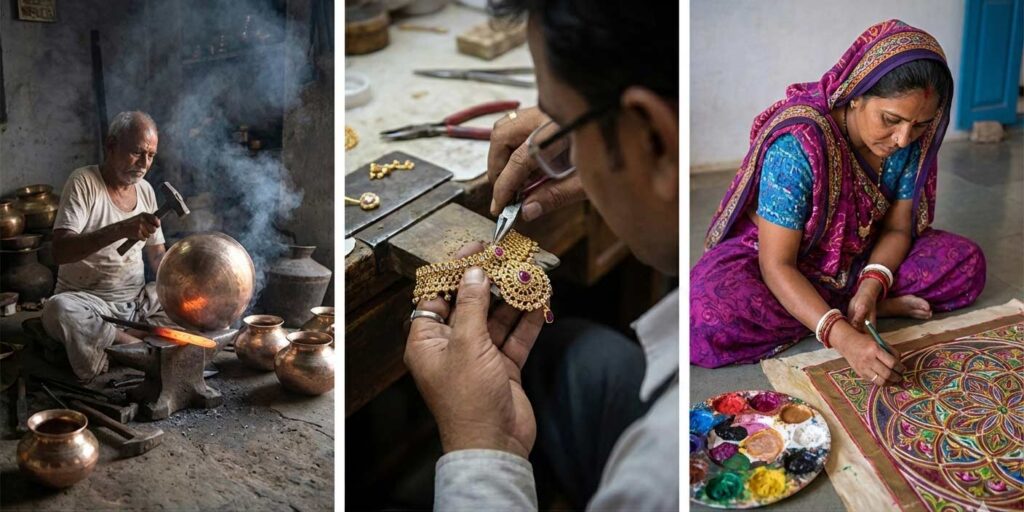
The Kansara Samaj boasts a rare distinction: a documented history of 900 years specifically working with bronze, Silver, gold and Rogan art. This is not just a trade; it is a long-term research project passed down through oral tradition and practical apprenticeship.
Over these nine centuries, the community developed:
- The “Purest Bronze” Technology: A specialized understanding of heat and composition that prevents the metal from becoming brittle or impure.
- Innovation in Metallurgy: While bronze was the foundation, the community’s “unique aptitude for craftsmanship” naturally led them to master the two other great metals: Gold and Silver.
- Rogan Painting: Kansara is master of Rogan oil painting. continue Rogan art traditional work in Madhapar by Ashish Kansara family
4. Expansion into Fine Arts: The Rogan Connection
While many artisanal communities focus on a single medium, the Kansaras of the Kutch region—specifically families like the Ashish Kansara family of Madhapar—achieved a rare feat. They translated their precision with metal into the delicate world of Rogan Art.
Rogan, which involves using a castor-oil-based paste to create “metal-like” patterns on fabric, became a natural extension of the Kansara creative spirit. It allowed the community to express the same “innovative metalwork” aesthetic on textiles, creating a visual bridge between the forge and the loom.
5. Heritage as Identity
For the Kansara Samaj, history is not found in textbooks, but in the hammer marks on a bronze vessel and the intricate filigree of a silver ornament.
“Bronze is not just a metal. It is our pride, lineage, and heritage.”
Today, the Samaj remains a tight-knit community that balances ancient technological “know-how” with modern business innovation, ensuring that the sound of the hammer—the heartbeat of their 900-year history—never fades.